
Flawed Inference and Selective Pekingology
Is the PRC Government Pressuring Tesla?

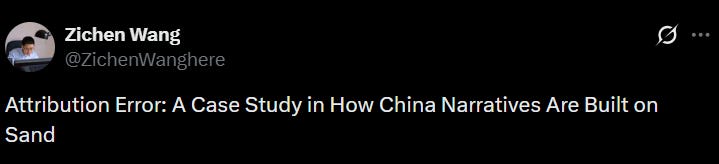
Pekingology’s Zichen Wang published a lengthy and somewhat inaccurate post that pointedly uses one of my Tweets as the cover image.1 Here is my reply.
The “Controversy”: Some days ago, Noah Smith and I retweeted a viral piece from the news site Electrek which speculated that the Chinese government was amplifying a viral story on how a Tesla Model Y lost power on the highway. Zichen frames his piece around those retweets to make the “case against the popular EV news site and two influential voices.” He finds an “attribution error” in the Electrek story and then inflates it into a broader piece arguing “China narratives are build on sand” and there is no campaign against Tesla.
Zichen makes three critical errors in his post: (1) he not only overstates the “attribution error” but makes one of his own, (2) he omits critical information that contradicts his argument and indicates Electrek’s was directionally right, and (3) he in no way counters the point that China is putting pressure on Tesla.
Zichen’s Narrow Argument: Zichen’s post is based one key point. Electrek cited a "china.com” story to show that the Chinese government was amplifying news critical of Tesla. But in doing so, Electrek apparently confused the portal china.com with the government-linked site china.com.cn: the latter actually is under the State Council Information Office and on the CAC list of central key news websites, and the former is not. Zichen questions China.com’s state links and implies this misattribution means that concerns about government pressure on Tesla are the product of “narratives built on sand.” But that is an inferential leap and almost certainly wrong.
First, Zichen misses that China.com is also under state control: Zichen’s claim that China.com has “no publicly known affiliation to the Chinese government’s press office” (i.e., the Propaganda Department) is incorrect and is a form of the very “attribution error” he criticizes. Public filings show China.com was de facto under the Propaganda Department for years (it was owned by the state’s China Radio International) before being sold to a company controlled by the Chengdu government. This is not a purely commercial actor, and certainly not one free from state influence when it comes to which stories it amplifies. Zichen claims “China-watching” requires analysts to “verify the institution; verify the attribution; then interpret,” but it is not entirely clear his analysis follows his own formula. Yes, the China.com link is not the strongest evidence of a campaign against Tesla, but it is neither irrelevant nor is it is it the only evidence an objective analyst might consider, which leads to the next point.
Second, Zichen misses that this story went viral in ways that suggest his conclusion may be flawed and that Electrek’s story is directionally right. The Tesla story was much bigger than one misattributed China.com post. The piece originated in New Yellow River (which is state-owned), but it then went out to most major Chinese “commercial” sites that amplify content, and it has stayed up: Sohu.com (under significant government influence), Sina.com (under significant government influence), ThePaper.cn’s app (state-owned), and even some regional television stations (government-owned). It went viral on social media, particularly in Chinese automotive corners. And it seemingly marked a reversal in Beijing’s approach to Tesla. Electrek notes that the Chinese government previously ran interference for Tesla and against Chinese citizens in the media and court (not a great look for Tesla). The fact that this story is popping up now and has stayed relevant across so many Chinese portals is consistent with a change in policy towards Tesla (more on that below). Given this evidence, it is entirely plausible that the government is leveraging “commercial” media to push a “consumer safety” angle without directly involving the most high-profile state media.
Third, Zichen is wrong to use the Electrek story to suggest there is no campaign against Tesla. If one really wanted to make the case there was no campaign in the press, it would be worth at least studying whether the regulatory environment has changed in ways that disadvantage Tesla and showing that it had not. But Zichen does not do this, and his focus on China.com is actually a distraction from what is understood by many at Tesla itself, industry analysts, trade associations, and the U.S. government: that China got what it wanted from Tesla and is now prioritizing domestic companies as the EV market turns cutthroat, with Tesla’s market share falling. Tesla is to blame for some of its problems (old models in a competitive environment), but there are signals of changing policy that will further complicate its future. The Ministry of Industry and Information Technology (MIIT) along with relevant standard-setting bodies are pushing a wave of new regulations that effectively (1) ban Tesla’s signature hidden door handles (enacted), (2) reverses Tesla’s design trends by mandating physical buttons on the dashboard (still in draft form), and (3) effectively bans Tesla’s yoke-style steering wheel (enacted). Tesla is not the only company with these features, and it was a Xiaomi crash that supposedly launched the door handle process, but state media frequently refer to these as “Tesla” features, and these regulations disproportionately affect Tesla. Critically, most of Tesla’s Chinese competitors were directly involved as part of the “key drafting units” (起草单位) for these regulations—Tesla was not. And in an unusually direct article, state-owned China Daily directly rebutted Elon Musk’s hope that he might soon receive Full Self-Driving approval by indicating “China [is] not about to approve Tesla self-driving tech soon.” Tesla was denied Level-3 approval for autonomous driving, though some domestic models received it. In the past, Tesla benefited from Chinese industrial policy, as Zichen notes. But he misses that, now, Chinese industrial policy is looks to be turning against it.
Ultimately, Zichen’s piece rests on a fundamental flaw in inference. It treats an attribution error, which he also makes, as an indictment of broader “China narratives.” And it ignores critical evidence in the media ecosystem and the regulatory landscape that suggest the Electrek piece may have had flawed support but the right overall argument. Correcting a sourcing mistake is laudable, but it is not the same as debunking the underlying claim, and Zichen's leap from one to the other is precisely the kind of inferential error he accuses others of making.
It is worth noting, for context rather than argument, that Pekingology is housed at an organization with links to the United Front Work Department, which takes as its charge influencing foreign opinion on China among other objectives. This fact that does not automatically invalidate Pekingology’s analysis, but is relevant background when evaluating a publication whose editorial posture appears to prioritize challenging unfavorable narratives about China over following the evidence wherever it leads.
Good response, but you're confusing Pekingology (CSIS's excellent podcast) with Pekingnology (Zichen Wang's commentary).
Gotta love how he claims that CCG, his danwei, is "NON-GOVT" in all caps in his Twitter bio. Putting it in all caps definitely makes it more believable! Apparently the China Center for Globalization is exempt from the Party charter's claim that 党政军民学,东西南北中,党是领导一切的 (for non-Chinese readers, “Party, government, military, civilian, and academic; east, west, south, north, and center, the Party leads in everything.”).